
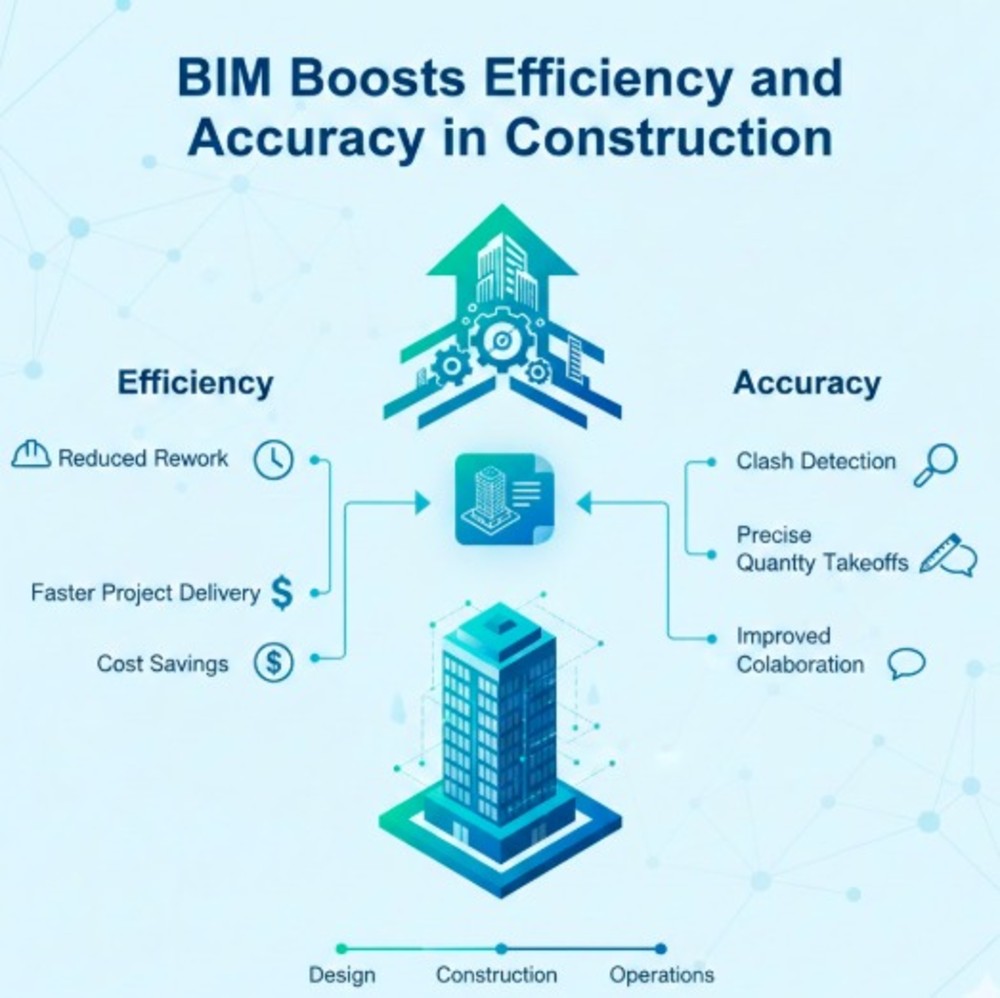
BIM Boosts Efficiency and Accuracy in Construction
The concept of Building Information Modelling (BIM) is an information technology process that is used in the planning, development, and administration of information of built assets during their lifecycle, including creation, construction, and use. In comparison to the conventional 2D drafting, BIM incorporates geometry, spatial relationship, and rich data in a single digital platform. The construction industry is one of the industries that are highly transformed by this innovation, which has had its challenges in the past such as fragmented processes, silos of information and a slow growth in productivity. The move towards BIM is mainly driven by the necessity to reduce the inefficiencies including design mistakes, rework, and interdisciplinary lack of collaboration. More governments and large clients are requiring the use of BIM in projects as it has the potential to improve transparency, lessen potential risks, and offer better value to money. The surveys conducted in the industry show that there is an increased use of BIM with it becoming a norm in the majority of the sophisticated construction markets.
BIM in the Contemporary Construction Space.
To architects, contractors and engineers, BIM transforms the manner in which a project is envisaged and executed. Integrated design environments give architects an advantage, coordinated analytical models give engineers an advantage and constructible, data-rich representations that assist planning and cost control give contractors an advantage. In its essence, BIM brings a more data-driven and integrated way of working. BIM facilitates the teams to work together on a single, authoritative model, which is how better efficiency, waste reduction, and more predictable outcomes of the project are established (Bryde et al., 2013).
What is BIM?
Building Information Modeling (BIM) refers to the digital representation of both the physical and functional characteristics of a facility that is utilized as a knowledge base to be shared between the various stages of the lifecycle of a project. The centralization of information, interdisciplinary interoperability and lifecycle integration are among the key principles. Project teams are involved in the development of a federated model in the long run such that geometry and data are kept up to date and traceable.
BIM in AEC (Architecture, engineering and construction) evolution.
- Automation of processes, eliminating paper-based and 2D CAD (Succar, 2009).
- Common models that allow cross-disciplinary and real-time collaboration (ISO, 2018).
- Growth of 3D visualisation to 4D (time) and 5D (cost) BIM, which connects models to schedules and costs (Eastman et al., 2011).
- Supporting analysis, simulation and asset management, increasing data accuracy and reliability (Azhar, 2011).
This development is indicative of an overall trend in the industry to deliver projects more integrated and data-driven.
The benefits of BIM in Construction Projects
More Fluent Cooperation and Communication
BIM provides a universal digital platform on which architects, engineers, and contractors can collaborate on coherent models to minimize the fragmentation and misinterpretation of information that usually causes delays and disputes in construction projects. BIM helps designers to think collectively across disciplines by visualizing design intent in three dimensions and combining technical information instead of finding solutions on the ground.
Quickened Decision Making by means of centralized information.
The centralized model-based information system enables stakeholders to access real-time project data and automatically update design changes, minimizing manual input. This speeds up decision-making by allowing the evaluation of design options, costs, and program impacts in one environment. Additionally, integrating BIM estimating processes links quantities to model elements, facilitating quick and accurate cost feedback.
Automated Clash Auto-Detect and Rework
Clash detection in Building Information Modeling (BIM) Automated clash detection in Building Information Modeling (BIM) is a great boost to efficiency since building structure, mechanical, and architectural systems are identified as incompatible with each other before construction, thereby avoiding expensive on-site alterations. Studies indicate that these conflicts could be addressed in time to save a lot of rework and associated delays.
Better Scheduling and Sequencing
In extending models to 4D, BIM will connect components to construction activities and thus teams can simulate sequences and learn about logistical constraints (Kymmell, 2008). This promotes better planning and risk-free operations of the sites.
There are major efficiency results:
- Previous conflict identification and risk aversion.
- Removal of manual drawing amendments.
- Reduced approval and coordination.
- More timely and better procurement planning.
Together, these processes prove how BIM can change disjointed workflows into unified, effective project delivery processes.
Improving BIM in the various project stages and enhancing accuracy
Accuracy of Measures, Quantities and Specifications
BIM improves accuracy by integrating parametric data into model elements, maintaining consistent dimensions and specifications. Unlike traditional 2D drawings that depend on manual interpretation, BIM automates scheduling based on geometry, minimizing human error. This approach allows for immediate reflection of design changes in design and data tables, aligning intent with documentation.
BIM Estimation tools provide greater cost fore-casting
BIM enhances cost forecasting reliability via 5D integration, enabling dynamic linking of quantities and costs to model components. It supports real-time estimation and trial budget scenarios, fostering transparency among designers, cost consultants, and contractors. This model-based approach improves cost data consistency and timeliness, facilitating informed financial decision-making.
Less Change Orders and Reduction of Errors
BIM can also minimise documentation mistakes that usually result in change orders in construction through the centralisation of information and automating the process of coordination. Love et al. (2013) reveal that one of the key contributors to rework costs is design related errors, BIM reduces such risks by early validation and coordinated outputs.
The main benefits of accuracy are:
- Less quantity errors due to automated take-offs (Eastman et al., 2011).
- More efficient coordination of sites based on common and updated models (Bryde et al., 2013).
- Precise details about fabrication, in favor of off-site fabrication and prefabrication (Sacks et al., 2018).
BIM has developed a single source of truth across the project stages so that sound and up-to-date data can be utilized to make decisions
Practical Applications of BIM in Construction
Design & Visualization
BIM allows the 3D immersive visualization to develop the understanding of the design among both technical and non-technical stakeholders. It enables space experimentation and early identification of problems leading to improved decision-making and less late-stage design changes.
BIM 3D Simulation and Conflict Resolution.
BIM optimizes the construction operation through planning of construction sequence, logistics, and simulation of the system interaction. It uses clash detection software to detect clashes between structural, mechanical and architectural components at an early stage and avoids the waste of money at the construction site due to rework. There is also 4D scenario testing that is used to optimize sequencing and site layout to enhance safety and constructability.
BIM Facilities Management Post-Construction
BIM goes beyond delivery to operations in BIM Facilities Management. As-built models are digital storage of equipment data, warranty and maintenance needs (Volk et al., 2014). This changes the set of handover documents into a living information system, which is used to support long-term asset performance.
Typical use cases include:
- Building systems asset tracking (Volk et al., 2014).
- Scheduling of maintenance, using embedded equipment information.
- Space management with precise latest spatial models.
- Refurbishment and decommissioning lifecycle documentation.
These applications reflect the use of BIM as a lifelong information support.
Key Benefits for Construction Teams
Benefits for Architects
Integrated design environments provide architects with quick repetition and performance analysis. BIM enhances the quality of design since it reveals spatial conflicts at early stages and assists in evidence-based decision making (Azhar, 2011). Clarity of the visual also hastens the client engagement and approvals.
Benefits for Engineers
The ability of engineers to have coordinated analytical models minimizes the disparity in disciplines. They can also test structural and services systems in shared environments, which enhances precision and minimizes the redesign cycles (Sacks et al., 2018).
Contractors and Project Manager Benefits.
Contractors use BIM to conduct constructability review, sequence and procurement planning. Information of the model minimizes uncertainty and enhances site coordination and cost and programme control (Bryde et al., 2013).
The advantages of cross-disciplinary are:
- Quicker approvals by more visual communication.
- Better documentation that is more consistent and traceable (Eastman et al., 2011).
- Less information coordination leads to fewer RFIs.
- Saving of costs through waste reduction and rework (Love et al., 2013).
- Improved liaison with expert trades.
In general, BIM unites professional goals around common, trustworthy information.
BIM for Cost Estimation & Budget Control
5D BIM revolutionizes cost information generation and management by continuously updating costs as design changes occur, unlike traditional estimation methods. It enhances precision by extracting quantitatively and automatically, supports real-time testing of financial feasibility and accelerates feedback in the early design stages when budget effects carry the greatest importance. Moreover, the combination of scheduling data and costs allows accurate prediction of cash flow and improved cost control, which reduces budget overruns and post-facto value engineering. In short, BIM is a data-driven cost management, but in a proactive form.
Challenges, Adoption Barriers & Considerations
Implementation Costs & Training Requirements
The implementation of BIM involves spending on software, hardware and training of staff. New forms of competencies to be developed by organisations include modelling, coordination and information management (Succar, 2009).
Software & Hardware Compatibility Issues
Inter-platform fragmentation may impede cooperation, and it happens especially when teams use systems that are not compatible with each other (Bosch-Sijtsema et al., 2019).
Gaps in Data Management and Interoperability
In spite of the standards like ISO 19650, the information exchange is still impacted by the inconsistency of data structures and naming conventions (ISO, 2018).
Organizational Change Resistance
The culture resistance is also a major obstacle especially in companies that are used to the linear, document-based processes (Succar, 2009).
Common challenges include:
- Lack of skills in modelling and data management.
- Licensing and infrastructural expenses.
- Temporal workflow interference during transition.
- Lack of confidence regarding shared accountability and ownership of models.
These problems have to be solved through strategic leadership, guidelines and long term devotion.
BIM Future in the Construction Industry
The future of Building Information Modeling (BIM) involves greater integration with digital technologies, such as artificial intelligence for design optimization and risk forecasting, and Digital Twin models for real-time asset performance tracking. BIM Facilities Management is improved with the use of cloud-based modeling and IoT systems that use live data feeds. These developments facilitate the whole process of asset life, conceptualization to decommissioning. Moreover, BIM has been relevant in environmental, social, and governance (ESG) efforts, as it enhances the estimation of energy use, carbon footprint, and material efficiency, which makes it a key platform in evidence-based design and asset management in projects that are sustainable.
Conclusion
The nature of BIM (Building Information modeling) is that due to the integration of the digital models, the construction process has been made more centralized, which has also made the project more efficient and accurate in the process of execution during the various stages of the project (Eastman et al., 2011). It minimises the number of errors, speeds up decision-making, and supports the work of multidisciplinary teams through the provision of a shared source of truth. Moreover, BIM can be applied to Facilities Management and use the data to maintain the performance of assets in the building lifecycle (Volk et al., 2014). BIM offers a systematic way of smarter construction practices in response to industry requirements on cost, time, and sustainability. The implementation of BIM to companies is able to generate greater quality output, less wastage and greater response to complexities not only a technological transformation but also a strategic transformation towards knowledge based integrated practices.
Office Details / About
US Bid Estimating & Engineering helps construction professionals navigate digital transformation through evidence-based BIM strategy and implementation. We enhance project clarity, price assurance, and lifecycle performance while enabling teams to deliver smarter, more resilient built environments.
Address: 98 Cutter Mill Rd, Great Neck Plaza, NY 11021, United States
FAQs
What makes BIM better than the traditional CAD?
BIM is an integration of geometry and data, and it enables coordinated model-driven processes rather than 2D graphics that are not linked to one another (Eastman et al., 2011).
Increase or decrease in project risk with the help of BIM?
Yes. The early identification of clashes and documenting them in a coordinated way limits design errors and rework, which are major causes of project risk (Bryde et al., 2013).
How does BIM-estimating work?
BIM-estimating is a method that takes the quantities out of the model elements, and this allows the continuous and precise cost feedback to be provided as the design evolves (Azhar, 2011).
Does BIM facilitate Facilities Management?
BIM Facilities Management involves the management of assets, maintenance and space using as-built models during the operational life of a building (Volk et al., 2014).
Do government projects necessitate the use of BIM?
BIM is required on government projects to enhance transparency and value, e.g. the BIM Level 2 requirement in the UK (HM Government, 2015).
Which are the teams that are most benefited by BIM?
Teams like architects, engineers, and contractors benefit from BIM’s accuracy and coordination. Expert BIM estimating companies can boost these advantages.